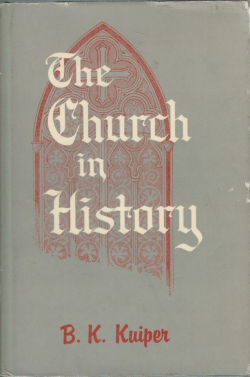
The Church in History
B. K. Kuiper
- 英文書名
- The Church in History
- 出版社
- Wm. B. Eerdmans Publishing Co
- 出版年份
- 1951
- 索書號
- MI 0330.0000
- 媒體類型
- Book
- 主題
- BR0151
內容簡介
Part I: When the Christian church was young -- 1. The new testament church is born, A.D. 33 -- The setting -- The church is born -- God is the creator and keeper of the church -- 2. The church grows outwardly, 33-313 -- The young church is beautiful -- Its beauty is marred -- It weathers a crisis -- The first turning point in the history of the church -- Saul becomes an apostle of Christ -- The second turning point in the history of the church -- The way is prepared beforehand for the outward growth of the church -- The church experiences unparalleled growth -- 3. The church grows inwardly, 33-325 -- What is meant by the church's inward growth -- Is doctrine important? -- The apostolic fathers search for truth -- The apologists study and defend the truth -- New and false ideas arise -- A creed and a canon emerge -- An organization develops -- The church fathers clarify and publish the truth -- The Nicene creed proclaims the deity of Christ -- 4. The church is tempered, 33-313 -- The heroic age of the church -- Peter, John, Stephen, and James are the first to be persecuted -- Paul suffers for his faith -- Nero, the first emperor to persecute Christians -- Ignatius, Justin, and Polycarp suffer martyrdom -- Persecution is continued under Marcus Aurelius -- There is a lull in the storm -- Determined efforts are made to destroy the church -- Galerius calls a halt -- 5. The church is victorious, 313 -- "In this sign, conquer" -- The edict of Milan grants equality -- the church's victory is a marvel -- The third turning point in the history of the church -- The world invades the church -- The problem of the relation of church and state has its beginnings here -- Julian fails to revive heathenism -- 6. The church consolidates, 325-451 -- The role of church councils -- A review of the council of Nicaea -- The council of Constantinople declares the deity of the Holy Spirit -- The council of Chalcedon confesses that Christ is human and divine -- Ambrose defends the truth and promotes Christian living -- Jerome serves the church -- "A son of so many prayers cannot be lost" -- Augustine defends and expounds the teachings of scripture -- The papacy develops -- 7. The church deteriorates, 100-461 -- Many evils were present -- Signs of deterioration can be detected from the very beginning -- The causes of deterioration are many -- Heathenism influences the early church -- Monasticism develops -- The church begins to persecute heretics 8. The church survives and grows again, 376-754 -- A summary of the growth of the ancient church -- Rome is the center of a great empire -- German tribes invade the empire -- The empire falls but the church survives -- The distribution of peoples after the barbarian conquests -- The church faces a twofold task -- The ancient civilization is preserved and transmitted -- The Franks are converted -- Ireland, Scotland, and England are Christianized -- Germany and the Netherlands are evangelized -- A summary of the conquests of the church -- Pope Gregory the great symbolizes the medieval church -- Part II. The church in the middle ages -- 9. The church loses territory, 632-732 -- The curtain opens on a scene of disaster -- Mohammed founds a new religion -- The Mohammedans conquer many imperial provinces -- The cross faces the crescent in the battle of Tours -- The conversion of Clovis has far-reaching consequences -- The losses sustained by the church are many and serious -- The causes for defeat -- 10. The church is divided, 1054 -- Europe in the year 1000 -- The fourth turning point in the history of the church -- The church in the east remains unchanged -- The church separates into two parts -- the Greek eastern and the Latin western church -- The eastern church is quiescent; the western church enters an eventful period -- 11. The church forms an alliance, 751-800 -- The Lombards drive the popes into the arms of the Franks -- The conversion of Clovis proves to have further significance -- A king asks sanctification of a pope and opens a long struggle -- The pope becomes a temporal ruler -- Charles becomes Charlemagne -- Charlemagne Accomplishes much by hard work -- There are three great empires at the time of Charlemagne's death -- The alliance between the church and the Franks has very important consequences -- 12. The church develops its organization, 461-1073 -- A review of the organization of the church -- The position of the pope was strengthened by the course of history -- The establishment of the papacy is aided by deceit -- Pope Nicholas I makes great claims for the papacy 13. The church in bondage to the state, 885-1049 -- The Norsemen plunge Europe in disorder -- Feudalism develops -- The Normans make themselves at home -- The popes become the football of the Italian feudal lords -- The popes become dependant upon the German emperors -- The papacy is sold -- 14. The church develops monasticism -- The spiritual life of the church is marred by sin -- Decay of religious life gives rise to Ascetism and Monasticism -- Monasticism is based on error -- The monastery at Cluny stresses reform -- 15. The church makes efforts to free itself, 1049-1058 -- A review of four stages in the roman church -- The Cluny reformers enlist the aid of emperor Henry III -- Pope Leo IX frees the church from bondage to the Italian nobles -- Poe Leo IX and the schism between east and west -- The Cluny reformers face a dilemma -- Pope Stephen IX side-steps an opportunity for reform -- Hildebrand becomes the power behind the papal throne -- 16. The church continues efforts to free itself, 1059-1073 -- Hildebrand practices clever diplomacy -- A new method is drawn up for electing a pope -- Pope Alexander II strengthens the papal position -- A dispute arises between pope and emperor -- Hildebrand becomes pope -- 17. The church faces a great struggle, 1073 -- A review of four important turning points -- The conversion of Constantine has three significant results -- The problem arises of the proper relation between church and state -- There are three possible solutions -- The stage is set for a terrific struggle -- 18. The church is forced to compromise, 1073-1122 -- Hildebrand's early life -- Cluny reform ideas are Hildebrand's inspiration -- The struggle for the right of investiture is a battle of survival -- Emperor Henry IV challenges pope Gregory VII -- Actual hostilities are opened by the pope -- The pope excommunicates the emperor -- The emperor pretends submission -- The emperor sets out for Italy to seek absolution -- The emperor waits in the courtyard of Canossa -- The pope and emperor meet -- The real drama of Canossa lay beneath the surface -- The struggle continues and confusion reigns -- The struggle ends in compromise in the concordant of Worms -- 19. The church inspires the crusades, 1096-1291 -- The world setting for the crusades -- The Turks are hostile toward the pilgrims -- Pope Urban II initiates the first crusade -- Results of the crusades are far-reaching rather than immediate -- The motive of the crusades is based on error 20. The church rises to the greatest height of its power, 1198-1216 -- Another emperor humbles himself -- Innocent III makes great claims for the papacy -- Five things favor Innocent's rise to power -- The papacy reaches its greatest height of temporal power -- The Lateran council declares for church reform -- There is indeed need for reform -- The Dominican order is founded -- The Franciscan order is established -- The Mendicant orders go about doing good -- A revival of culture begins -- 21. The church declines in power, 1294-1417 -- Papal power declines under pope Boniface VIII -- The fifth turning point in the history of the church -- The "Babylonian captivity," 1305-1376 -- The papacy is torn by the great schism, 1378-1417 -- 22. The church is stirred, 1200-1517 -- The struggle for supremacy ends -- The crusades affect the church -- The Albigenses spread their heretical ideas -- The Waldenses seek to lead the church back to simple Christianity -- The church resorts to persecution to suppress heresy -- Wycliffe teaches the need for reform -- Huss preaches reform in Bohemia -- Wycliffe's bones are burned -- Three general church councils fail to bring about reform -- The renaissance has both good and bad effects -- The brethren of the common life attempt reform in the Netherlands -- A review of influences that have stirred the church -- The church stands on the threshold of the reformation -- Part III. The church in the reformation -- 23. The church is shaken, October 31, 1517 -- A new era opens -- The sacrament of penance becomes central in the catholic religion -- The practice of indulgences arises -- The system of indulgences gives general satisfaction -- Luther's early life -- Luther's conversion -- Luther posts the ninety-five theses -- Luther is already a man of high attainments -- He is still a catholic in good standing -- Posting of theses is a common practice -- The ninety-five theses are published and widely read -- The theses have an immediate effect -- Their real significance is recognized by the church -- 24. The church is convulsed, 1517-1521 -- The spotlight turns on Luther -- Luther is summoned to Rome -- Cajetan fails to silence Luther -- Von Miltitz is seemingly more successful -- The pope dawdles and Eck challenges Luther to a debate -- Luther denies the infallibility of the church -- The Leipzig debate has several important results -- The storm gathers -- Two books influence Luther -- The storm breaks -- Luther issues three great reformation treatises -- Luther burns the pope's bull Luther is summoned by the emperor -- Luther journeys to Worms -- Luther appears before the Diet of Worms -- The political question is settled but the religious question remains -- Luther makes a second appearance before the Diet -- Luther stands firm -- Luther is carried off to Wartburg castle 25. The church is reformed in Germany and Scandinavia, 1520-1530 -- The reformation is also an influence outside the church -- The time was ripe for reformation -- Luther restores Christian liberty -- Luther develops a form of church government -- Luther provides the people with materials for study and worship -- Luther has many helpers -- The church in the Scandinavian countries is reformed -- 26. The church is reformed in German Switzerland, 1523-1529 -- Zwingli comes under the influence of Luther -- Zwingli reforms the church in Switzerland -- Zwingli differs from Luther -- Zwingli meets an early death -- 27. The church is reformed in French Switzerland, 1541-1555 -- Calvin's early life and education -- Farel brings the reformation to Geneva -- At this time almost all protestants are Lutherans -- Calvin works with Farel in Geneva -- Calvin enjoys three years of peace in Strassburg -- Calvin returns to Geneva -- His great work in Geneva influences all Europe -- How Calvin and Luther differed -- Calvin and Luther can be numbered among the heroes of faith -- 28. The church is reformed in France, 1541-1559, and in the Netherlands, 1561-1571 -- The reformation had its roots in the past -- Le Fèvre prepares the way in France -- Luther has wide influence in France -- Calvin provides the necessary leadership -- The reformation in France comes to maturity -- The way has been prepared for the reformation in the Netherlands -- 29. The church is reformed in Scotland, 1557-1570 -- The way is prepared for the reformation in Scotland -- Calvin influences Scotland through Knox -- The preaching of Knox revolutionizes Scotland -- The church in Scotland is organized -- The church is firmly established -- 30. The church is reformed in England, 1543-1563 -- Wycliffe had early prepared England for reform -- Tyndale translates the Bible for the English -- Henry VIII declares the king head of the church of England -- Henry makes other changes in the church -- The reformation makes progress under Edward VI -- There is strong catholic reaction under Bloody Mary -- The reformation becomes victorious under Elizabeth -- Many forces were active in the reformation in England -- 31. The roman church undertakes reform, 1545-1563 -- Reform is universally desired -- Ximenes works a reform in Spain -- Charles V chooses between Luther and Aleander -- Pope Adrian VI attempts to reform the church -- Adrian's rule is not without Influence -- The council of Trent attempts an inner reform -- 32. The protestant churches fight for their life, 1546-1648 -- Charles V tries to uproot the reformation -- The reformation movement comes to a stand-still -- Other forces affect Protestantism -- Protestantism fights for its life in France, 1562-1629 -- The protestants in the Netherlands revolt against Spain, 1568-1609 -- German protestants wage war for thirty years, 1618-1648 -- The wars of the reformation carve out territory for Protestantism -- Part IV. The church after the reformation -- 33. The church in the post-reformation era -- Western Europe is still disquieted -- The word always has been and remains basic -- Differences in explaining the word give rise to reform and separation -- The visible church follows four distinct lines -- A preview of post-reformation developments -- 34. The church in England continues to Ferment, 1558-1689 -- The reformation in England is prolonged -- The influence of Calvin is felt in England -- The puritans desire to reform the church of England -- The separatists or Congregationalists leave the church of England -- The puritans gain the upper hand -- The Westminster assembly does its work well -- Puritan domination ends -- The restoration brings suffering to puritans and dissenters -- 35. The conflict between Catholics and protestants continues, 1667-1690 -- Political motives are now uppermost -- Louis XIV persecutes the Huguenots -- William III comes to the rescue of England -- England enjoys a measure of religious toleration -- 36. The rise and growth of the Congregationalists -- Robert Browne spreads congregational ideas -- Congregationalism grows in the face of opposition -- A new English Bible is obtained through puritan effort -- Smyth, Brewster, and Robinson advance Congregationalism -- Cromwell favors congregationalism -- The Congregationalists adopt the Westminster confession -- They share in persecution and struggle for freedom -- Congregational churches decline and grow strong again -- 37. The rise and growth of the Baptists -- The Anabaptists are dissatisfied with the reformers -- Many practice community of goods -- Fanatics cause confusion and conflict -- Melchior Hofmann influences multitudes -- Jan Matthys becomes leader -- The Munster kingdom is a sad failure -- Some essential doctrines of the Anabaptists -- The Anabaptists stand for liberty of religion -- The Mennonites continue the Anabaptist tradition -- The Baptists divide into general and particular Baptists -- Some similarities between Congregationalists and Baptists -- 38. Serious departures from historic Protestantism -- Socinianism denies the trinity -- Socinianism becomes Unitarianism -- Arminius denies election and other historic doctrines -- The synod of Dort rejects Arminian doctrines -- Arminianism lives on -- George Fox, founder of Quakerism -- Fox's teachings -- The Quakers increase in numbers -- 39. More moderate departures from historic Protestantism -- Pietism is a new movement in the Lutheran church -- Spener believes Christianity is a life -- Spener meets opposition -- Francke takes over -- Francke proves to be an able organizer -- Francke encourages the work of missions -- Pietism has serious defects -- Followers of Huss organize the "unity of the brethren" -- A pietist youth witnesses for Christ -- The brethren establish Herrnhut and are called Moravians -- The Moravians organize as a church -- The Moravians lead the way in the work of missions 40. The origin and development of Methodism -- John Wesley's birth and early childhood -- Charles Wesley establishes a club -- In America the Wesleys are influenced by the Moravians -- The Wesleys are converted -- Religious conditions in England are deplorable -- There are a few rays of light -- John Wesley is a remarkable preacher -- Wesley organized Methodist societies -- The Methodist church comes into existence -- Wesley employs unusual methods -- Wesley's doctrine is Arminian -- His influence is immeasurable -- 41. Modernism's break with historic Christianity -- Churches holding to supernatural revelation -- Modernism rejects the supernatural -- 42. The eastern and the roman church since the reformation, 1648 to the present -- The history of the eastern church flows on without interruption -- The eastern church resists Mohammedanism and atheism -- The roman church declares the infallibility of the pope -- 43. Controversy continues in Germany and England -- Doctrinal differences disturb the Lutheran church -- Modernism invades the church and the universities -- Socinianism undermines the Presbyterian church in England -- Deism discredits the Bible -- The church of England has a low, a high, and a broad church movement -- Three movements arise among the non-conformists -- 44. The reformed churches survive persecution -- The reformed church in Switzerland revives and wanes -- The Huguenots in France survive horrible persecution -- Antoine court and Paul Rabout guide the persecuted church -- The reformed church survives the French revolution -- The reformed church in Germany grows and then declines -- Lay-patronage divides the Presbyterian church in Scotland -- The reformed church in the Netherlands deteriorates and revives -- Abraham Kuyper is converted -- Kuyper gives a half century of strong leadership -- Kuyper's method of reform is different -- 45. The church grows once more, 1500 to the present -- Earlier periods of growth -- The growth of the church is checked -- Voyages of discovery open the world to the church -- The Catholics do mission work -- The protestants carry the gospel to other lands -- Missionary results -- Part V. The church in the United States -- 46. The church is extended into the new world -- The episcopal church is the first in America -- The Congregationalists church is established in New England -- The Dutch reformed come to New York and New Jersey -- Roger Williams founds a Baptist church -- The Catholics experience slow growth in the colonial era -- The Quakers persist in the face of persecution -- The German reformed settle in Pennsylvania -- The Lutherans weather a crisis -- Various German groups make their homes in America -- Presbyterianism takes root and grows rapidly -- Methodism arrives late in the colonial period -- 47. The church experiences a great awakening -- The colonies experience a spiritual awakening -- The work of Frelinghuysen, Tennent, and Edwards -- George Whitefield and the great awakening -- The aftermath -- 48. The church and the war for independence -- The great awakening promotes colonial unity -- The churches oppose the idea of an Anglican bishop for America -- The Episcopalians are divided in their loyalty -- most of the churches wholeheartedly support the war -- The churches at the end of the colonial period -- 49. The churches in the new national period -- The national period brings new developments -- The colonies disestablish their state churches -- Independent American churches organize on a national scale -- Other churches sever their European ties -- 50. The church moves west -- The westward movement is a challenge to the church -- The Presbyterians enter the west -- The Baptists work effectively on the frontier -- Methodism has strong appeal -- The roman Catholics make slow but steady progress 51. The church experiences a second awakening -- America at a low spiritual level -- A second awakening begins in the east -- Revivals and camp meetings sweep through the new west -- Several new denominations are formed -- Missionary societies and religious literature spread the gospel -- The American Sunday school union is formed -- The churches establish colleges and seminaries -- 52. The church in a time of turmoil -- Presbyterian Calvinists separate from liberals -- The Episcopal church expands and divides -- Immigration strengthens the orthodox Lutheran position -- Doctrine and language divide the German reformed -- Immigration swells the rolls of the Catholic church -- 53. The civil war and reconstruction periods -- Anti-slavery sentiment arises -- The churches divide on the slavery question -- The churches work among the negroes -- The westward movement continues -- Immigrants disregard the Puritan Sabbath -- The gospel is carried to those outside the church -- Dwight L. Moody -- a gifted evangelist -- Horace Bushnell criticizes revivalism -- 54. The church faces modern problems -- Wealth influences the church -- The church emphasizes social problems -- Steps are taken to improve religious education -- The church deals with problems of peace and war -- Modernism in recent years -- The effect of modernism on missions -- 55. The church seeks to preserve the faith -- The fundamentalists oppose the modernists -- Many fundamentalists accept premillenialism -- Holiness groups develop in the churches -- The reformed and the southern Presbyterians strive to maintain the truth -- Orthodox Presbyterians form a new church -- The Christian reformed church -- 56. The churches seek co-operation and union -- Two forces in the church: separation and co-operation -- The liberals and the Orthodox form federations -- Church union should be based on church unity -- International conferences strive for unity -- 57. A look backward and forward -- A look forward -- A look backward. 主題:
館藏冊數與狀態
| 分館 | 條碼 | 索書號 | 館藏位置 | 狀態 | 應還日期 |
|---|---|---|---|---|---|
| 松林總館 | 7159 | MI 0330.0000 | — | 可借 | — |