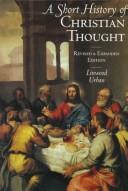
A Short History of Christian Thought
Linwood Urban
- 英文書名
- A Short History of Christian Thought
- 出版社
- Oxford University Press
- 出版年份
- 1986
- 國際標準書號
- 0195093488
- 國際標準書號(13碼)
- 9780195093483
- 索書號
- TH 0100.0111
- 媒體類型
- Book
- 主題
- BT0021
內容簡介
Scriptural sources -- God is Lord of all things -- God made a covenant with Israel -- God gave Israel the law -- God holds Israel to account -- God has a future for Israel -- The gospel of Thomas -- The picture of Jesus in the synoptic gospels -- The gospel of John and the epistles of Paul -- Paul's problem with the law -- Johannine literature -- The deity of Christ -- The preexistent Son and wisdom in the epistles of Paul -- The mystery of the Trinity -- The beginning of Trinitarian thinking -- Philo of Alexandria -- Pre-Nicene trinities -- Irenaeus' creedal statement -- Monarchianism -- Dynamic Monarchianism -- Modalistic Monarchianism -- The unity of God -- Multiplicity in God -- Arianism -- The Nicene reaction to Arianism -- Augustine and the coequal Trinity -- The social Trinity -- Karl Rahner's distinctions between the persons -- The mystery of the incarnation -- Early heresies -- Gnosticism -- The orthodox reply -- Word-flesh and word-man Christologies -- Apollinarianism -- Nestorianism -- Monophysitism -- The achievement of Chaldcedon -- Since Chalcedon -- The integrity of the natures -- Fallibility and human nature -- The unity of the person -- An organic theory -- Two types of Christologies -- Chalcedon again -- The atonement -- Types of evil -- Early accounts of the atonement -- The classic theory -- The devil is defeated -- Modern restatements of the classic theory -- Another modern reformulation -- The perfect sacrifice -- Further reflections -- Abelard's moral influence theory -- Luther's doctrine of justification by faith -- Atonement is many faceted -- The fall and original sin -- The traditional view -- Some distinctions -- The idea of sin in the Old Testament -- The story of the fall -- Jewish interpretations of the fall -- Jesus' view of sin -- Paul on the fall of Adam -- Primary and secondary sins -- Original sin among the early fathers -- The paradox of the knowledge of good and evil -- The perfection of Adam -- The motivelessness of the fall -- A Protestant-Catholic divergence -- Christianity without the historical Adam -- Original sin as "inherited" -- Reinhold Niebuhr -- Modern Roman Catholic perspectives -- Adam's sin as archetypal -- The age of natural theology -- The ontological argument -- Gaunilo's objection -- God as a construct -- Existence is not a real property -- Is God a possible idea? -- The cosmological argument -- Part one of St. Thomas' cosmological argument -- Part two of St. Thomas' cosmological argument -- David Hume's response -- The principle of sufficient reason -- An infinite series of conserving causes is impossible -- And this all men call God -- Assessment of the argument -- Arguments from design -- Hume's criticisms -- The theory of evolution -- The wider teleological argument -- A final criticism -- Omniscience and human freedom -- Augustine and predestination -- How God knows what he knows -- A contemporary discussion -- Omniscience and love -- The problem of evil -- Hume's Dialogues -- Considerations of omnipotence -- Considerations of benevolence -- The believer's answer -- The atheist's answer -- Natural theology: an appraisal -- Authority and revelation -- Hume's essay on miracles -- The scientific challenge -- The conservative response -- Infallibility -- Creation in seven days? -- The limits of reason and the need for revelation -- Limitations from human sin -- Limitations of speculative reason -- Kierkegaard and the absurd -- Revelation and reason -- Reason in support of authority -- The quest for the historical Jesus -- Howard Kee and Norman Perrin -- The failure of the quest for the historical Jesus -- Jesus known and unknown -- Discovering the foundations -- The priority of faith -- The reality of the unseen world -- The experience of the holy -- Mystical union -- Personalistic mysticism -- The theology of revelation -- A religious way of knowing -- The foundation theory -- The coherence theory -- The pragmatic theory -- Coherence and integration -- The fascination with being-itself -- The reality of being-itself -- The mystery of being -- Being and the holy -- Being and mystical awareness -- The liturgical and spiritual revival -- Recapitulation and prospectus -- The sacraments -- The universality of sacramental rites -- Ritual in the Hebrew Scriptures -- Gentile conversion -- Baptism in the new covenant -- The Eucharist in the New Testament -- Baptism and the Eucharist before the accession of Constantine -- Controversies over baptism -- Later repercussions on penance, confirmation, and first communion -- Eucharistic thinking in the fourth and fifth centuries -- Augustine and Ambrose on the Eucharistic sacrifice -- After Augustine and Ambrose -- Peter Lombard and St. Thomas Aquinas -- Eucharistic piety in the late Middle Ages -- The Reformation -- Luther's problems with self-sacrifice -- Reformation views on the Eucharist -- Objectivist and subjectivist views -- Reformation views on baptism -- The Council of Trent -- Trent and the passion -- Roman Catholic Eucharistic theology between Trent and Vatican II -- Protestant developments -- The ecumenical and liturgical movements -- Baptism and confirmation in contemporary discussion -- Rethinking the Eucharistic presence -- Subjectivist views reconsidered -- The Eucharist as sacrifice -- Conclusion -- The Church and the ministry -- The Spirit-filled community -- The Church as the body of Christ -- The ministry in the New Testament -- The ministry at the turn of the first century -- Apostolic succession -- The Church as catholic -- The Church as holy -- Clerical celibacy -- Seven sacraments and seven orders of the ministry -- The rise of the papacy -- The papacy in the Middle Ages -- The plenitude of papal power -- The city of God -- The Church falls on evil days -- The Reformation -- The Council of Trent -- Anglican thinking on the ministry -- Five models of the Church for the modern world -- Worship -- Preaching of the Word -- A community united in faith and love -- The Church as an agent of social justice -- Institutional renewal -- The Ecumenical movement -- The Roman Catholic Church and Vatican II -- Issues concerning the ministry after Vatican II -- The Church united? -- The papacy today -- Epilogue -- Christianity and other religions -- Judaism and Christianity -- The movement for women's rights -- The ordination of women -- Female symbols of God -- An open question? -- Conclusion.
館藏冊數與狀態
| 分館 | 條碼 | 索書號 | 館藏位置 | 狀態 | 應還日期 |
|---|---|---|---|---|---|
| 松林總館 | 5693 | TH 0100.0111 | — | 可借 | — |